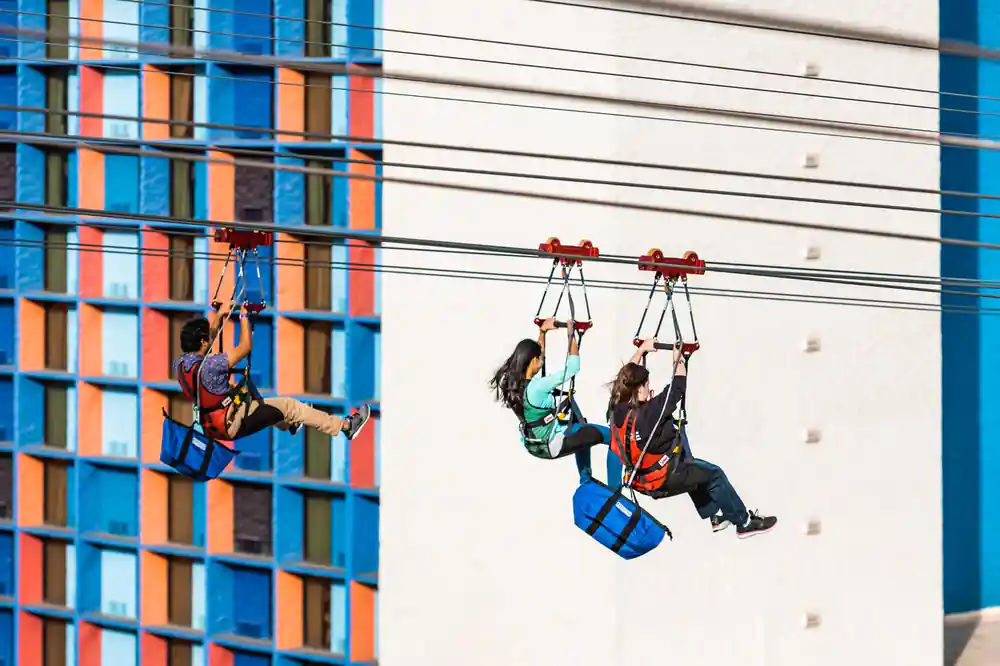
What to remember
- FLY LINQ will not seat anyone under 100 cm (3 ft 3 in) tall, a limit set by the harness rather than by age.
- The same harness sets a maximum weight of 136 kg, and that limit applies to every rider, adult or child.
- There is no age printed on the ticket. What decides whether a child can ride is how tall they are, not how old they are.
- Unaccompanied minors are not allowed on FLY LINQ. Any child riding must be with an adult.
The two numbers that decide who rides
FLY LINQ has two firm cutoffs, and they matter more than anything else on the ticket if you are travelling with a child, or with anyone close to either edge of an average adult build. A rider must be at least 100 cm tall, which is 3 ft 3 in, and must weigh no more than 136 kg. Both are checked at the harness, not guessed at from the ticket counter.
Both figures come from the same source: the harness that clips a rider to the line. It has a working range rather than a suggested one, and a person outside that range at either end is not sent up the tower. There is no exception made for a family that has travelled a long way to be there, and no version of the ride that skips the harness.
Why a minimum height exists at all
The reason is mechanical rather than arbitrary. A harness is built to grip a body within a certain size range, and below 100 cm (3 ft 3 in) it stops doing that job properly. A harness that is too loose is not a smaller, gentler version of a safe harness, it is a harness that does not hold the person wearing it, which is why the cutoff is set in centimetres and inches rather than in years.
The practical move for a parent is simple: measure your child at home, not at the front of the queue. A tape measure against a wall the night before tells you the truth several days in advance, in whichever unit your household actually uses, since 100 cm and 3 ft 3 in are the same line on the wall. Finding out on the promenade, with a harness already in someone's hands, is the harder way to learn it.
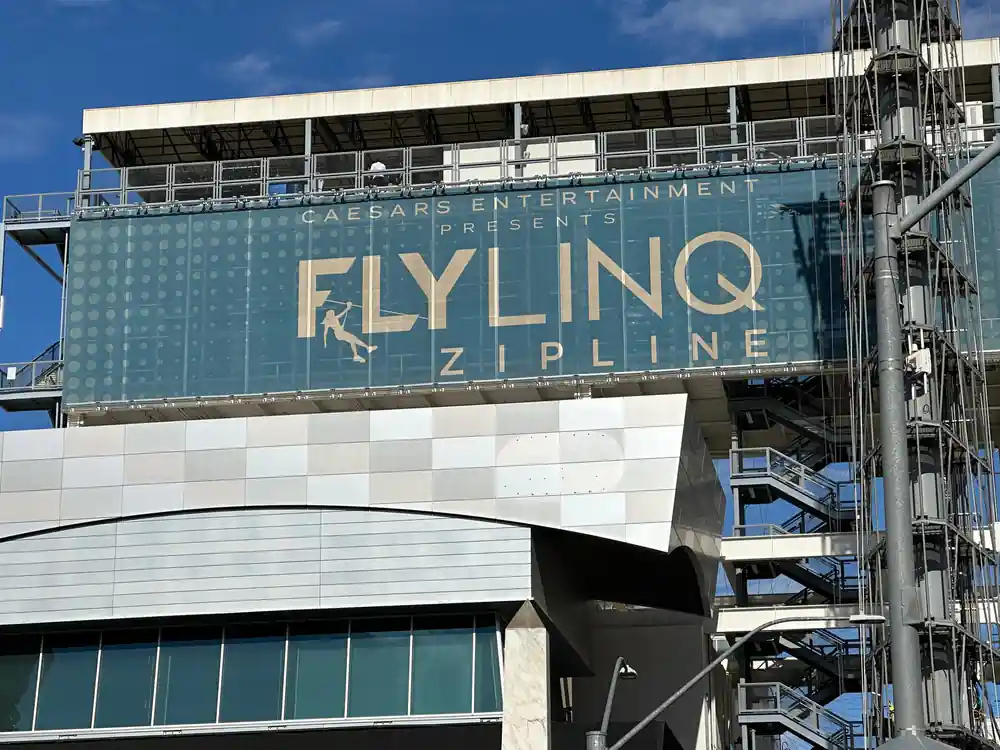
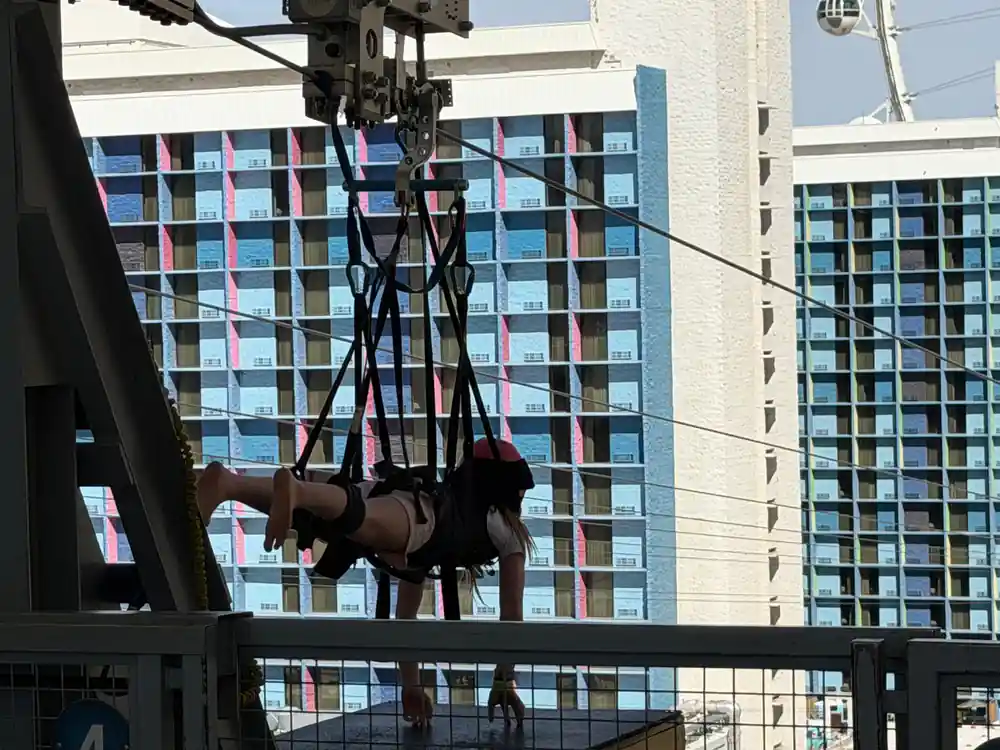
A rider being checked into a harness before heading up to the launch platform
A minimum height is not a minimum age
It is worth separating these two things, because they are easy to confuse and only one of them is actually on the ticket. FLY LINQ states a minimum height. It does not state a minimum age, so a young child who is tall enough clears the bar in exactly the same way an older child who is not tall enough does not.
That means the only useful question to ask before you go is how tall your child is right now, not how old they are, and not how tall their friends were at the same age. A birthday does not change a harness fit; a few centimetres does, in either direction.
If your child does not quite reach the mark
There is no way to soften a hard number, so it is worth being direct about it: a child measuring under 100 cm (3 ft 3 in) will not be fitted into the harness, and there is no smaller harness size that gets around it. That is true regardless of how confident the child is, or how much taller they look standing next to a shorter parent.
The useful response is timing rather than persuasion. Measure again closer to the date, since a few months of growth can close a gap of a centimetre or two, and treat the number as fixed on the day rather than as something to settle once a harness is already in someone's hands.
100 cm
FLY LINQ sets a minimum height of 100 cm, which is 3 ft 3 in, before a harness will hold a rider properly, with no age attached to it.
The weight limit, and who it applies to
The Vegas zipline weight limit is 136 kg, and it is not a rule reserved for children. It applies to every rider who steps into the harness, adult or child, because the equipment has the same working range for everybody who uses it that day.
There is no separate limit for adults and no different treatment by age on this one. One harness system, one weight ceiling, applied the same way to a parent, a teenager or a much younger child alongside them.
Riding with children: the adult rule
Height and weight are not the only requirement. FLY LINQ does not allow unaccompanied minors, so a child who is tall enough and light enough to meet both numbers above still cannot go up on their own. An adult has to be part of that ride, not just present somewhere nearby.
In practice, that means deciding before you arrive which adult is riding with which child. It is a separate rule from the two numbers above, and it stands on its own regardless of how comfortably a child clears the height and weight limits.
Getting this sorted before you reach the promenade
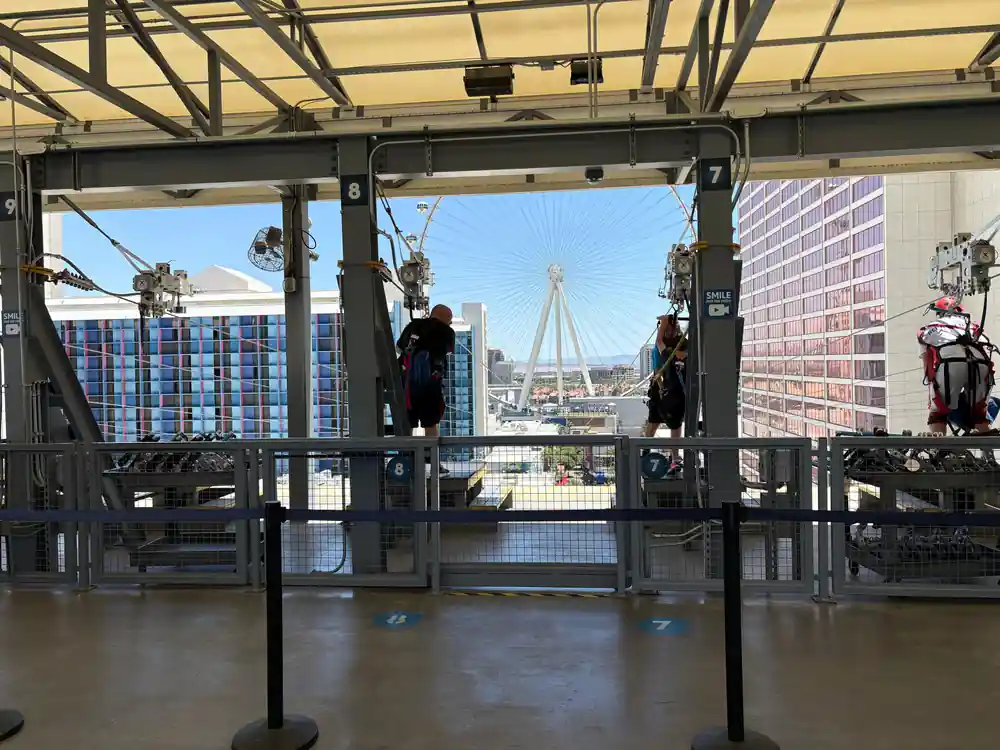
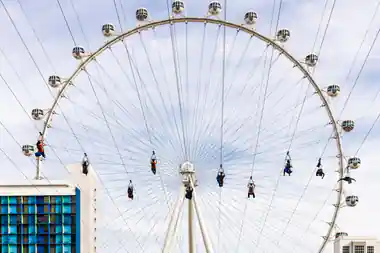
FLY LINQ sits above the LINQ Promenade on the Las Vegas Strip, with the High Roller marking the far end of it, and it is a ticket to ride rather than a scheduled tour with a group to check in with. That makes the height and weight requirements the actual gate on the day, checked at the harness and not negotiated with anyone at a desk.
The useful order of operations is the one that works for any attraction with a hard cutoff. Measure the child at home, in both centimetres and inches. Decide which adult is riding alongside them. Treat the 100 cm (3 ft 3 in) minimum and the 136 kg maximum as fixed rather than approximate. Working that out on the promenade, mid-queue, is the harder way to find out.
Cleared the height and weight requirements? Check FLY LINQ dates.
from US$43